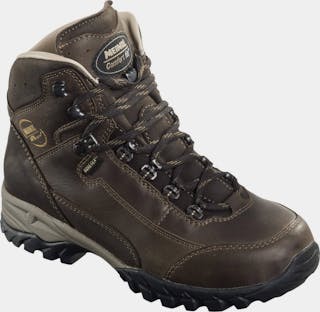
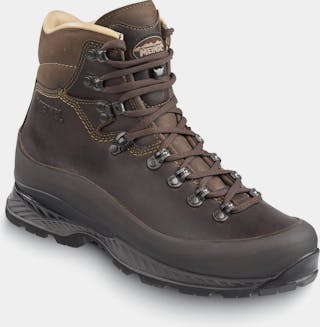
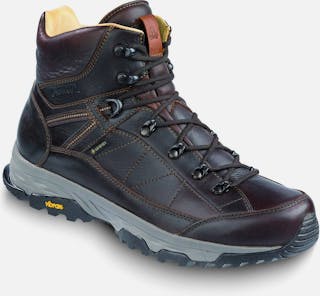
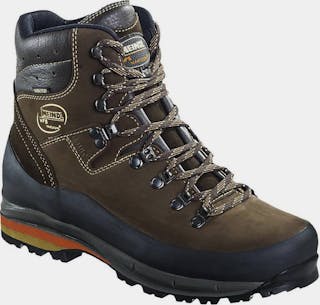
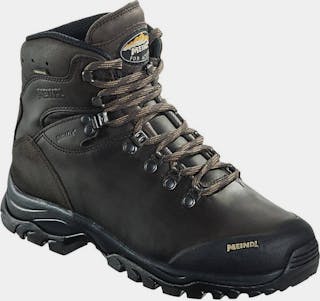
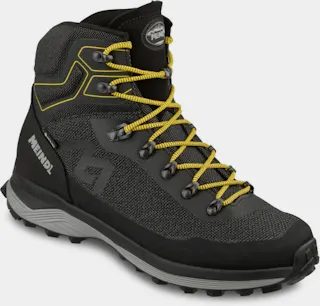
Hiking boots
Hiking boots support and protect your feet
The lighter the load you carry, the more flexible a boot you can choose. For backpacking trips, especially in tricky terrain, fairly stiff and sturdy footwear works best. Tested on hard surfaces, such as in a store, these boots feel emphatically stiff — but once you get out into the terrain carrying a pack, they turn out to be just right for the job. Many dog walkers even do all their walks in solid hiking boots.
Tips for choosing and caring
Read our blogs Breaking in new hiking boots and Hiking boot care guide.
Waterproof or non-membrane?
The vast majority of hiking boots sold in Finland come with a waterproof membrane. The popularity of Gore-Tex footwear owes a lot to our wet terrain, where rubber boots used to be standard kit for hikers. A hiking boot keeps your feet dry and also gives you the support you need when you’re walking — maybe already a bit tired — across rocky ground with a heavy load. For some hikers the right choice is a non-membrane hiking boot, so we’ve added those to our range too.
How to choose sturdy enough boots?
Hiking boots often come with a stiffness rating — this tells you how supportive and stiff the boot is. Category A and A/B boots suit day hikes and light trekking, while B, B/C and C category hiking boots suit more demanding terrain and carrying a heavy pack. They also genuinely support the ankle by covering the ankle bones with sturdy material. Some manufacturers use their own stiffness rating, but we aim to describe the suitable conditions for every boot. Stiffness refers both to ankle support and to the sole’s torsional and flex resistance. Thanks to clever lacing systems, even stiff boots can be tightened more over the instep and left looser at the cuff, which improves comfort on steep terrain, for example.
Care extends the life of your boots
Caring for your boots keeps them in good shape. Especially if you move a lot across boggy areas, it’s worth rinsing your boots with clean water after pretty much every use: this stops acidic bog water from doing its damage. It’s also good to wipe or brush off loose mud and dust from the surface. The leather and textile materials in your hiking boots are treated to be water-repellent. This not only protects against water but also helps keep the material breathable: once material is soaked through, water vapour can no longer escape. The surface treatment gradually wears off with use. You’ll notice this when you step into a puddle: on a new or freshly treated boot, water beads up nicely, whereas a worn treatment lets water soak into the surface material. Leather boots should also be waxed once or twice a year. Wax keeps the leather in good condition and stops it from drying out. Meindl and Nikwax make excellent boot care products that keep the surface of your boots in good shape. Always make sure the care product you use suits your footwear: products suitable for Gore-Tex footwear mention Gore-Tex separately. The products in our range are reliable and simple to use. Care for your boots — your feet will thank you!
If you take a break from using your hiking boots, it can sometimes happen that a hard surface forms on the sole material. You can tackle this surface with a wire brush without worry: just brush the tread so the surface breaks up a touch. Boots like being used: regular use, even light, keeps the midsole of hiking boots serviceable. Remember to store your hiking boots in a dark, cool place — and never on top of underfloor heating.
Hiking boots and hiking socks — a perfect pair
The best companion for hiking boots is hiking socks. We recommend wearing thin liner socks with medium-thick hiking socks over them. This way the socks rub against each other, which reduces skin chafing enormously. On longer hikes, changing the liner sock also gets you a long way, while the actual hiking sock easily handles several days of use without getting too dirty. The material of your hiking socks affects how warm your feet stay. In winter conditions, go for a high wool content in your socks; in summer, synthetics rule.
Even though Meindl hiking boots, for example, are usually great on your feet straight out of the box, we always recommend walking a few laps in new boots before setting off on your first trip. This starts the process of the footwear moulding to your particular feet and makes sure the boots don’t cause blisters.
Favourite brands and models
- Meindl is a true classic whose history reaches all the way back to the 17th century
- Hanwag competes for the top spots among European hiking boot brands
- Lowa is a favourite brand for many
- Lundhags makes sturdy hiking boots to their own unique recipe
Order now from a Finnish specialist store — deliveries right to your front door if you need, and the range includes wide-fit hiking boots too!