Does a gas stove work in winter?
There are plenty of opinions about how gas stoves perform in the cold. Some say they become unreliable at the first light frost, while others swear they'll keep going at -30 °C. The truth isn't that simple, and explaining it takes a slightly longer article.
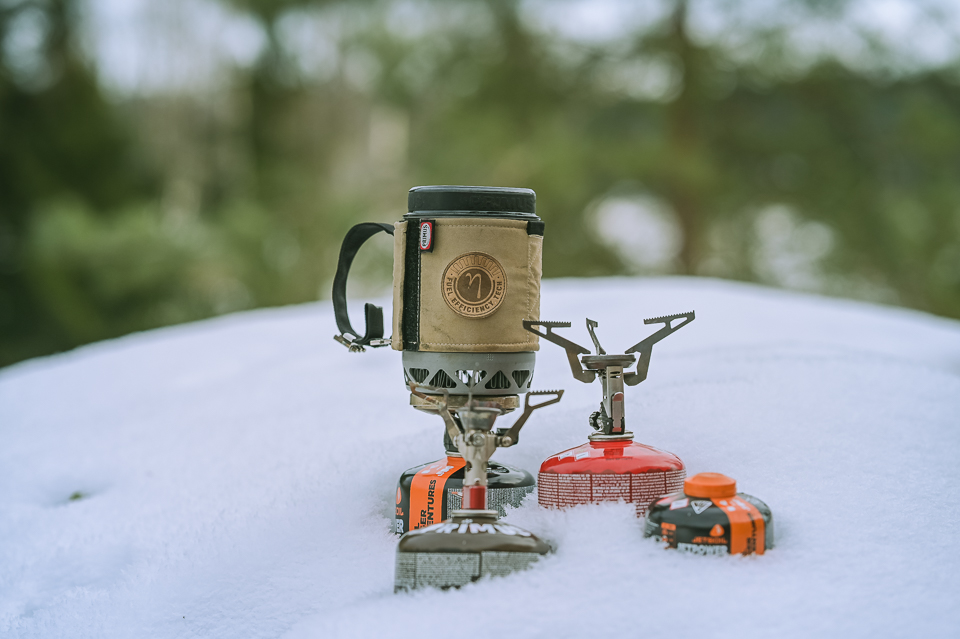
We tested two gas stoves in the temperatures most hikers actually head out in. We tried them at -4 °C, at -19 °C and, for comparison, at +19 °C.
We used the MSR Pocket Rocket 2 and Primus Lite Plus (the older model in our test) gas stoves, with Primus Winter Gas 230 g and Jetboil Jetpower 230 g as fuel. The two stoves differ a lot in output and aren't directly comparable – the main aim of the test was to look at the differences between the gases. Using two quite different stoves gave the test a bit more depth.
Do gas stoves work in winter – does winter gas help?
- Gas stoves do work below freezing, but output drops
- The colder it gets, the greater the loss of output
- At 19 °C there was no difference between summer gas and winter gas
- At -4 °C winter gas was clearly more efficient
- At -19 °C summer gas was already much slower
- Winter gas was slower below freezing than at 19 °C
- Winter gas performed almost equally well at -4 °C and -19 °C
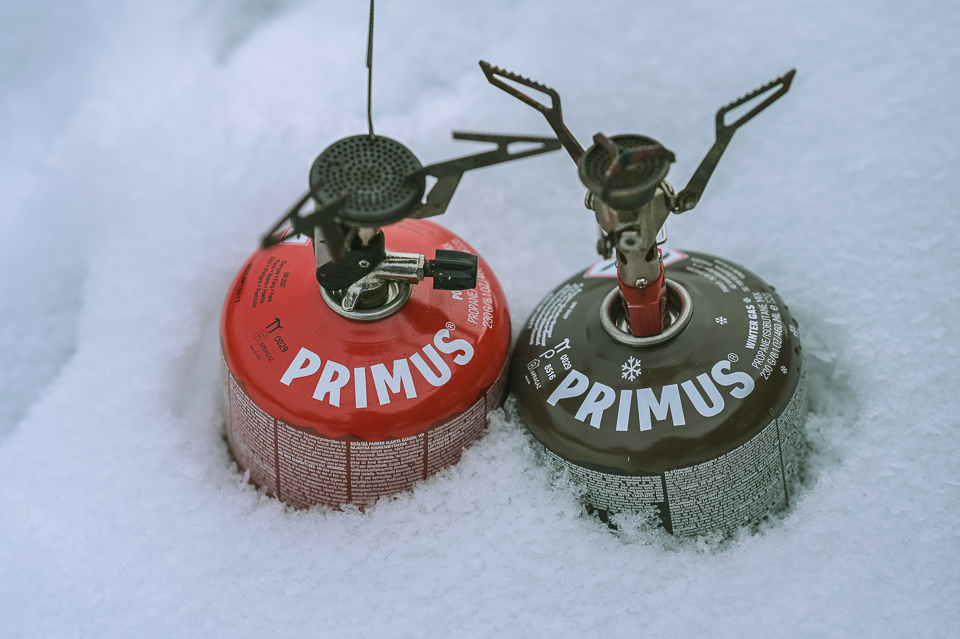
Our test was only a quick practical trial, and the reality isn't quite this simple. Stoves vary a lot: some work well even in fairly hard frost, while others may stop working altogether. The gas mixture also makes a big difference. There are plenty of variables – pot shape, how well the lid seals, windshield, air pressure, changes in canister pressure, the temperature of the pot material and so on.
What's the difference between winter and summer gas?
Jetboil states that its canister contains 25% propane, 70% isobutane and 5% n-butane. It's sold as a four-season gas, whereas some manufacturers use 20% propane and 80% isobutane, which doesn't perform as well in the cold.
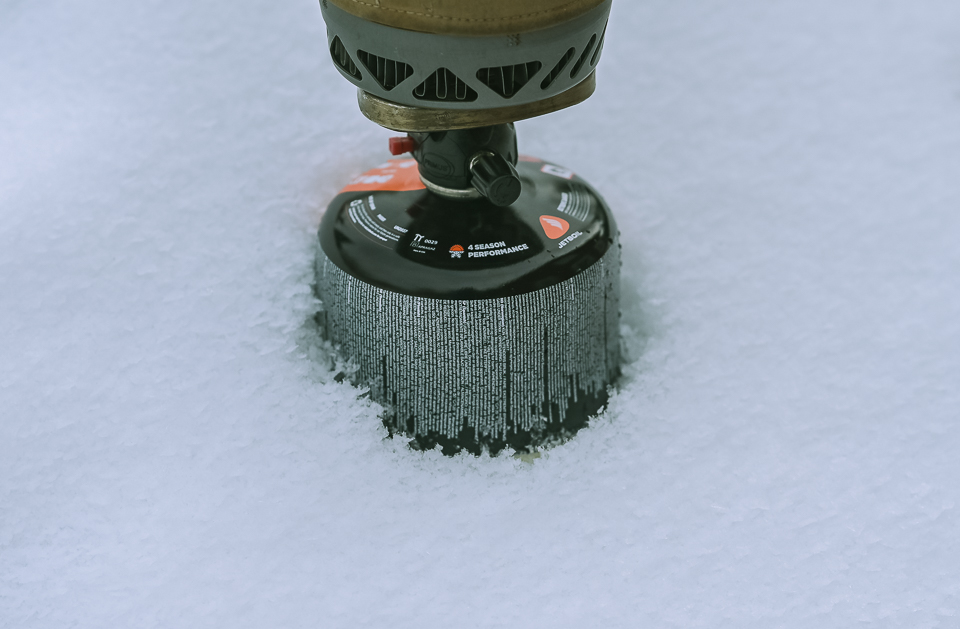
Jetboil's gas is actually marketed as a four-season gas.
Gas mixtures usually contain three components:
- Propane (boiling point −42 °C)
- Isobutane (boiling point −12 °C)
- N-butane (boiling point −0.5 °C)
Each gas has its own role. They're blended so the mixture works as well as possible as a camping fuel. Inside the canister, the gases are kept in liquid form under pressure.
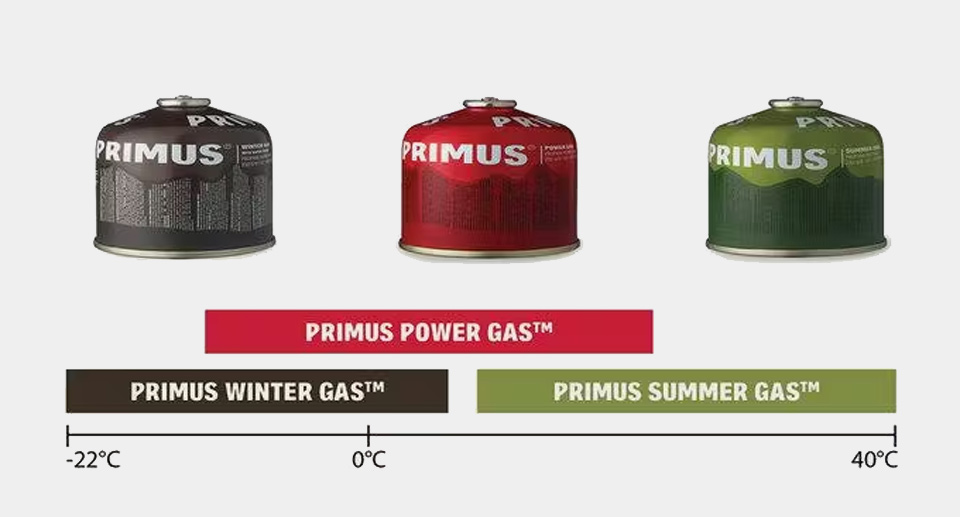
Primus offers a separate summer gas, Power Gas and winter gas. The winter gas is rated down to -22 °C, and it still performed really well at -19 °C.
Propane is familiar to anyone who barbecues. Its boiling point is -42 °C, and below that it can no longer vaporise. Propane also produces very high pressure – so high, in fact, that a canister filled with propane alone would need to be much sturdier. Current canisters couldn't handle it safely.
Isobutane is a safer gas because its pressure is lower, but its boiling point is -12 °C, so it doesn't perform well in real cold. A canister of pure isobutane wouldn't deliver reliable pressure, and it would cost more.
N-butane is cheap. It has the same chemical formula as isobutane but a different structure (isobutane is an isomer of butane). It works well in summer but stops vaporising close to zero.
In winter, a gas mixture works better with no n-butane at all and a higher share of propane.
The Primus Winter Gas canister doesn't state its mix ratio, but the biggest benefit actually comes from the “Vapor mesh” inside. This porous, paper-like “mesh sleeve” increases the contact surface between liquid and gas, so the liquefied gas vaporises significantly better in the cold. The result is a more efficient canister, as we saw in the test.
Why does a gas canister get cold when you use it?
If you've cooked outdoors, you've probably noticed the canister getting cold as you use it. So a mild enough air temperature isn't the whole story – you also need to factor in the canister cooling down. When the gas burns, two things happen inside the canister: the liquid gas vaporises, and vaporisation requires energy.
When a liquid turns into gas, it absorbs energy. That energy comes from the liquid inside the canister and from the canister's metal itself. Both the canister and its contents cool down as heat energy transfers into the gas.
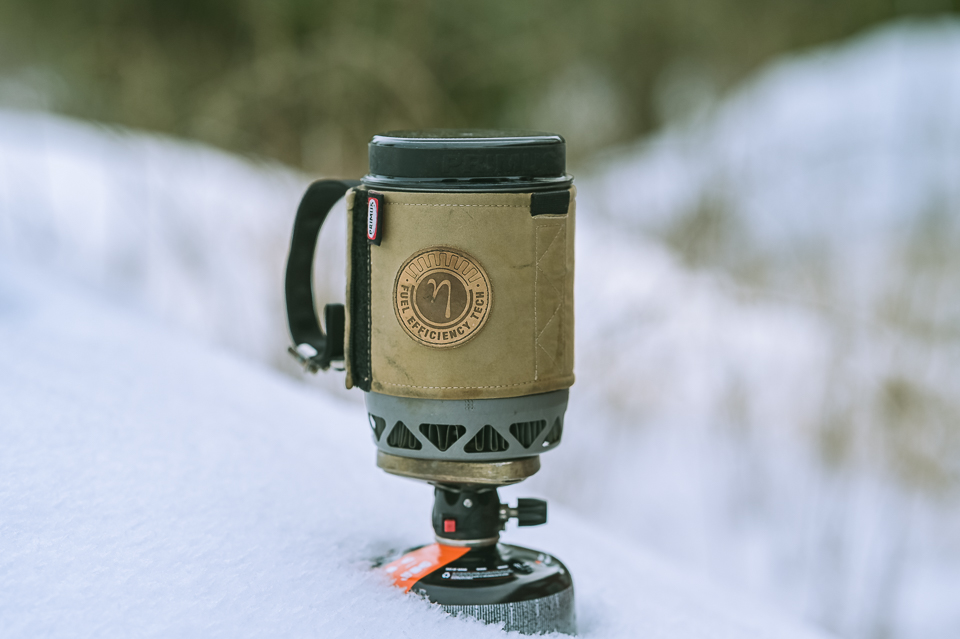
As the canister cools and its internal temperature drops, vaporisation slows down. Pressure falls, the flame weakens and, in practice, the stove loses output and your water takes longer to boil.
Example:
In summer: You start at +20 degrees and the canister temperature drops by 10 degrees. It's still +10 degrees inside, so vaporisation keeps working efficiently.
In winter: You start boiling water at −10 °C and the canister temperature drops by 10 degrees → −20 °C. The butane no longer vaporises. The stove burns more propane, leaving a proportionally larger share of butane in the canister. Pressure collapses, because propane has a higher pressure than butane.
Is fuel consumption the same with summer and winter gas?
You might be thinking that summer gas is slower, but surely it burns less fuel too – so all you lose is time? Does winter gas actually save fuel when you're cooking in the cold?
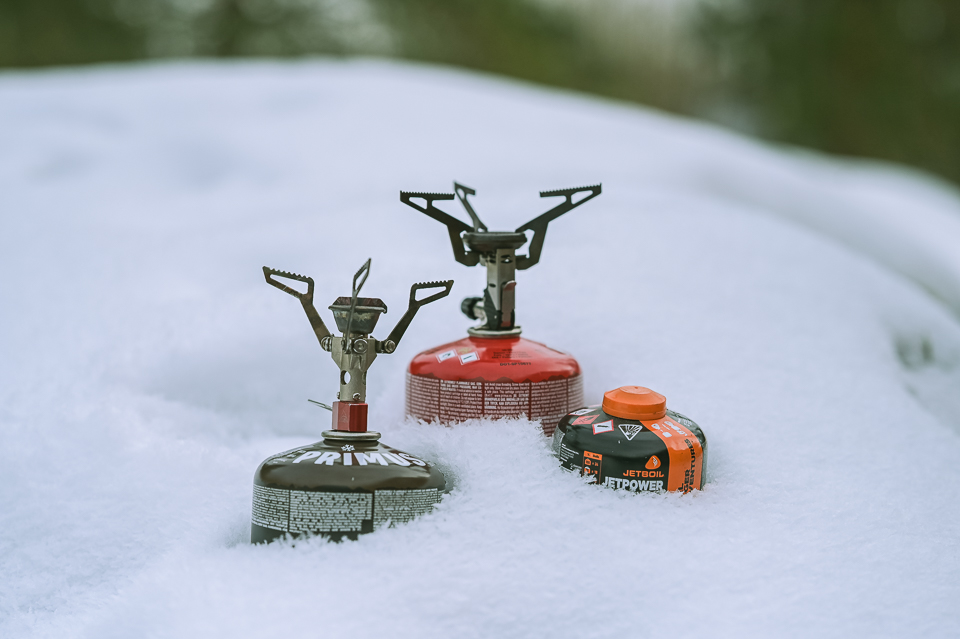
With summer gas, we found that pressure drops → the flame weakens and boiling time gets longer. In other words, the stove's output fell noticeably as the temperature dropped.
energy=power×time
If power drops, time increases disproportionately, so energy – in other words fuel consumption – goes up. Some heat is also lost because the pot sits out in the cold for longer. Summer gas is also more prone to “ghost burning”: the butane no longer vaporises and the stove burns only propane, which lowers the pressure even further. In practice, you can end up using as much as 10-30% more summer gas.
Tricks to get your gas canister working better in the cold
If the temperature drops well below -19 °C, most gas stoves start running into serious problems. Stoves vary a lot in how they cope with the cold.
- a regulated gas stove helps keep the pressure steady, but it can't increase it
- a remote-canister stove with a preheat tube works much better in the cold, as you can turn the canister upside down
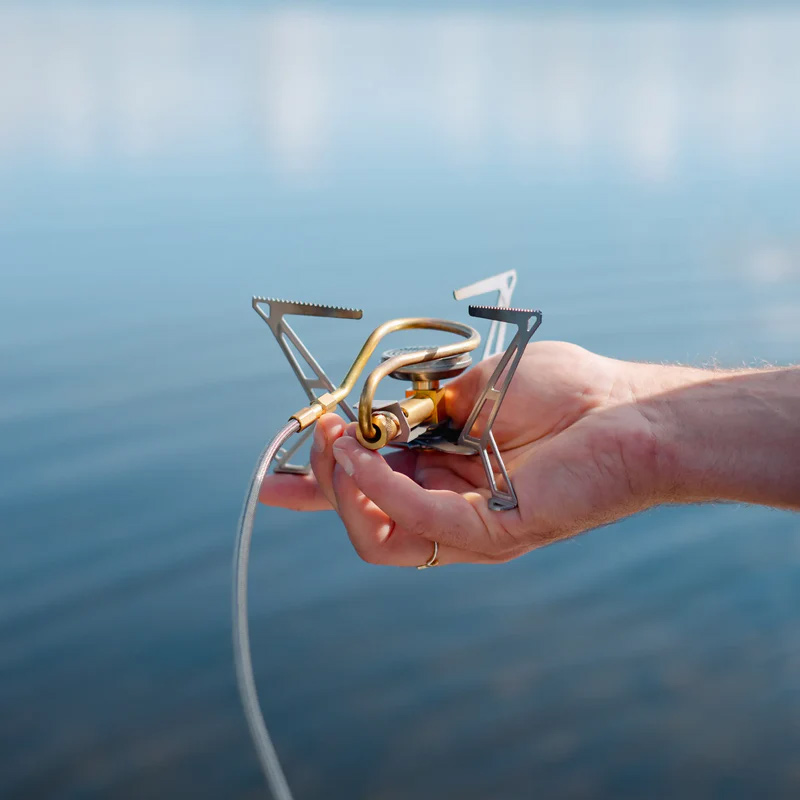
Pictured: the Primus Spider stove, with a hose to the fuel canister, a preheat tube and an output of 2000 W.
A remote-canister gas stove helps in cold weather. You can warm the canister beforehand – inside your jacket, for example – which helps get vaporisation going. You can also warm the canister in a container of warm water. Never overheat the canister or put it near a campfire.
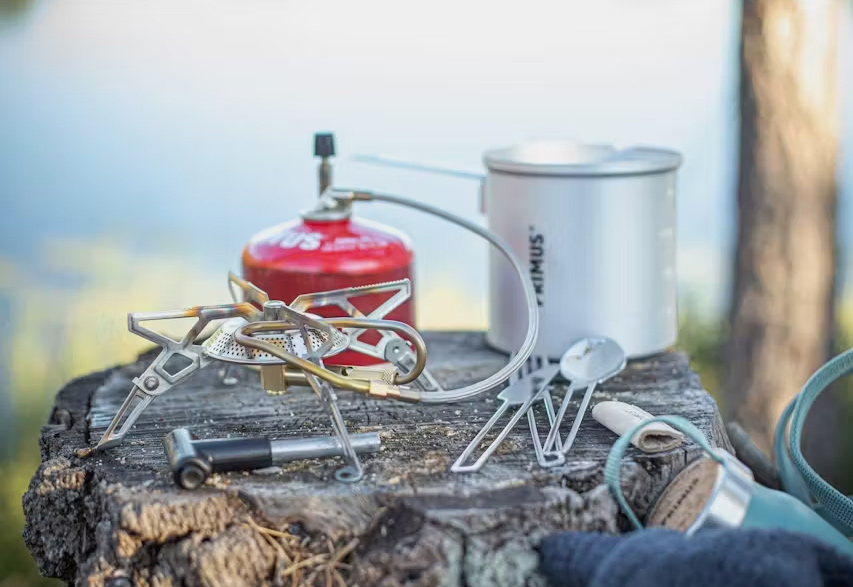
The Primus Gravity 3 stove also has a preheat tube and a hefty 3000 W output.
Your stove will work better with the canister “the wrong way up”. With a remote-canister stove, you can turn the canister upside down. First preheat the stove with the canister “the right way up”, and once the stove is hot after about 30 seconds, flip the canister “upside down”.
Inside the canister, there's gas at the top and liquid at the bottom. When the fuel is drawn from the bottom instead, the stove takes in “liquid” (liquid-phase gas), and vaporisation happens in the preheat tube rather than in the canister. Liquid gas doesn't separate according to vapour pressure, so the mixture leaves the canister in the same ratio as it is inside. This means the propane isn't used up first, and the butane doesn't get “left in the canister” to drag down the pressure.
Why is a “petrol stove” better in winter?
Alongside the gas stoves, we also tested the Primus Omnilite Ti multi-fuel stove. The Omnilite Ti has an output of 2600 W, while the gas stoves in the test – the Pocket Rocket 2 and the Primus Lite – are rated at 2400 W and 1500 W.
The Omnilite's results weren't consistent. The timings were also affected by how much pressure was pumped into the fuel bottle and how far the stove's control valve was opened. These were hard to replicate exactly every time, but our conclusions were:
- At +19 °C the Omnilite was the slowest of the stoves
- At -4 °C it was on par with the Pocket Rocket 2 and clearly faster than the Lite Plus
- At -19 °C it had the fastest boiling time of all
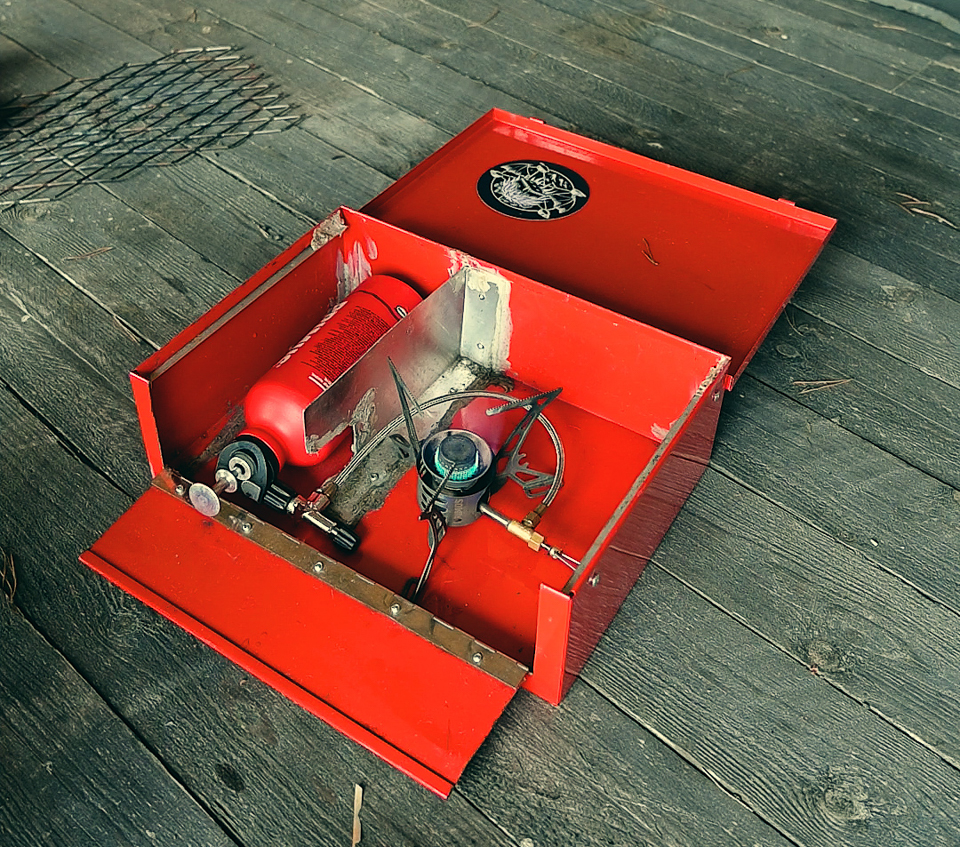
With a multi-fuel stove, it's worth using a stove box. The box gives the stove a stable, non-flammable base, and you can close it in an emergency.
Once you head into extreme cold, a multi-fuel stove becomes the more reliable option. In those conditions, multi-fuel stoves usually run on petrol, which is why they're commonly known as petrol stoves.
Propane stops vaporising at -42 °C, and once you factor in the canister cooling down, that can happen at much warmer temperatures in practice. Even Primus winter gas starts to become a risk once the mercury drops to around -20 °C.
The small-engine petrol used in petrol stoves – alkylate petrol – is pressurised with a separate pump (rather than relying on vapour pressure, as gas does), so it doesn't depend on temperature the way gas does.
Alkylate petrol doesn't freeze in normal winter use. In really hard frost it can thicken, form waxy crystals and eventually turn semi-solid. It still works as a fuel at -40 °C, although it vaporises less readily. In practice, the operating limit lies somewhere between −40 and −60 °C.